SRH Meet & Greet 2026 Event Branding
A live Meet & Greet event where fans, media, and three of the team's biggest stars would share the same space for one electric afternoon.
Nitin Monga
Designer · Developer · 3D Artist
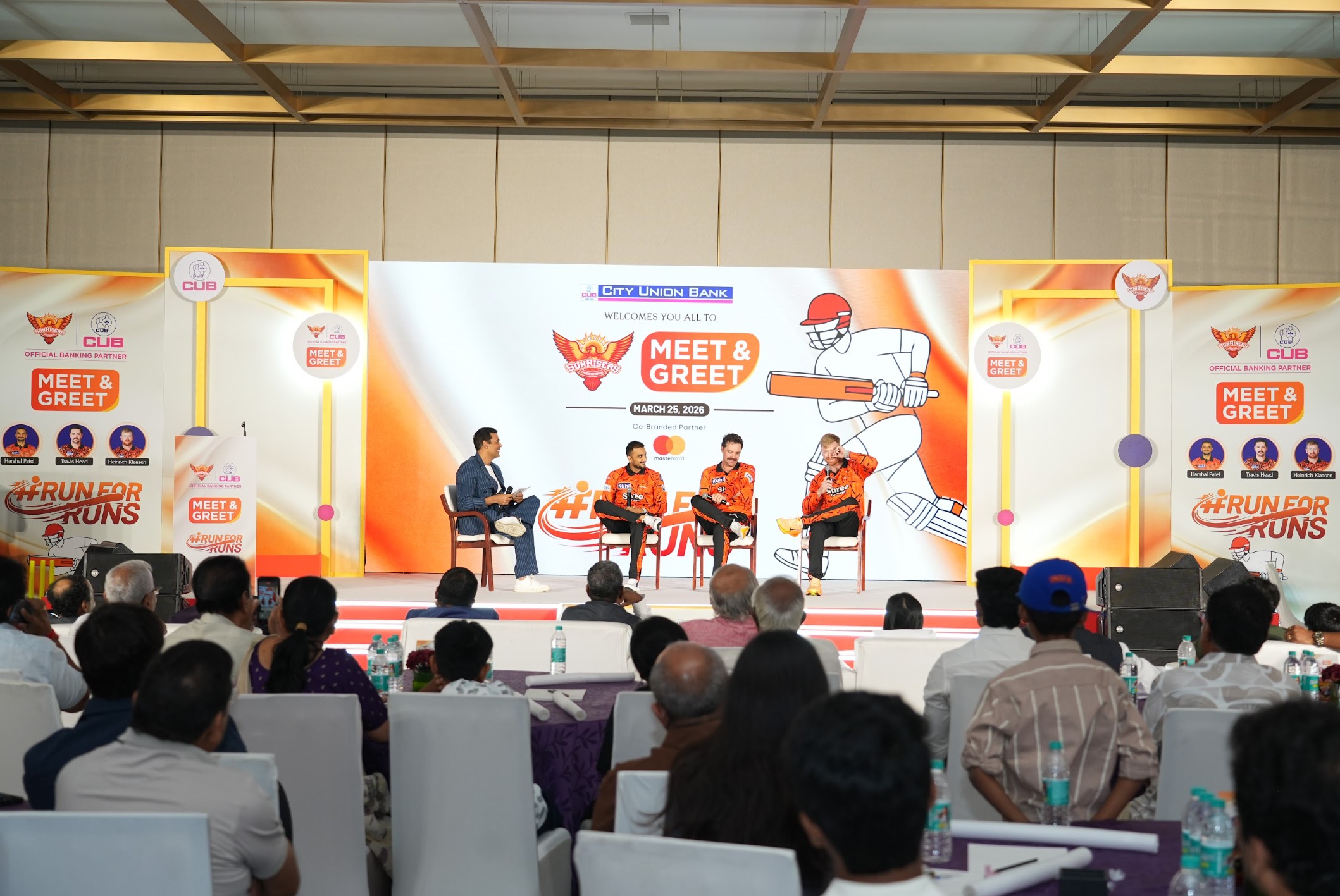
When City Union Bank partnered with Sunrisers Hyderabad as their official banking partner, the launch needed more than a press release. It needed a moment one that felt as charged as the IPL itself. A live Meet & Greet event where fans, media, and three of the team's biggest stars would share the same space for one electric afternoon.
I was brought in to design every visual element of that afternoon. Stage. Backdrop. Standees. Cue cards. Console box. Photo wall. Skirting. Every printed surface that would appear on camera, in social posts, and behind the players. Nothing was off the table — and nothing could be off-brand.
The brief in one line: Make a banking partnership feel like a cricket match.
My Role
• Full visual identity for the event — start to finish
• Stage and backdrop design with LED-ready specifications
• All on-ground branding: standees, ramps, photo-op walls, skirting
• Print collateral: cue cards, console box wrap, table signage
• Brand integration across two distinct identities — SRH and CUB
• Production-ready files coordinated with the fabrication team
The Challenge
Two brands. One stage. No compromise.
Sunrisers Hyderabad lives in fiery orange — high-energy, sun-soaked, instantly recognizable. City Union Bank lives in trust — calm gradients, hot pink accents, established since 1904. Two identities that, on paper, do not want to sit in the same room.
My job was to make them sit together so naturally that no one would notice they were ever separate. Not a logo lockup pasted onto a backdrop. A complete visual world that belonged to both brands at once.
The constraints
Two brand identities
Orange-dominant for SRH, pink/white for CUB — needed a system that let both lead without fighting
Live event environment
Every surface had to read clearly under bright lights, on phone cameras, and from the back of the hall
Camera-first design
The backdrop would appear in every photo, every Instagram story, every news clip — it had to compose like a frame
Production timeline
All files needed to be fabrication-ready in a tight window with zero room for revision after print
Multi-surface coherence
Stage, standees, console box, photo wall, skirting — different scales, materials, and viewing distances, all needed to feel like one event
The Process
Step 1 — Decoding the brands
Before designing anything, I spent time inside both brand worlds. SRH's orange is not just a color — it is a temperature. It carries the heat of the stadium, the speed of the bowl, the rush of a six. CUB's identity is the opposite — quiet, considered, generational. I needed to find where these two emotional registers could meet without one drowning the other.
The answer was a layered hierarchy. Orange would set the energy. White space would carry the calm. Pink would tie the corporate identity in without ever competing for attention. The hashtag — #RunForRuns — would be the bridge: a phrase that worked for both a cricket innings and a marathon fundraiser.
Step 2 — Building the visual system
I started with the LED backdrop because it would set the visual language for everything else. Stark white background to give the players visual contrast on camera. A flowing orange ribbon to carry the SRH energy across the surface. The CUB logo at top center, anchoring the corporate partnership without screaming for attention. A graphic batsman illustration in mid-swing — not a photo, deliberately, because illustration lets the brand colors stay pure.
Once the backdrop language was locked, every other surface followed the same rules. The side standees became smaller echoes of the main wall — orange wave behind a yellow frame, player headshots, the same #RunForRuns lockup. The console box and ramp branding picked up the orange-and-white striped motif. The skirting carried the gradient through to the audience level.
Step 3 — Designing for the camera
A live event is a photo shoot you cannot reshoot. Every angle had to compose well. I designed the backdrop knowing where the chairs would sit, where the host would stand, where photographers would line up. The negative space between the typography and the illustration was deliberately wide — so when three players sat in front, their faces would not collide with the graphics behind them.
The side standees were positioned to frame the stage from wide-angle shots without dominating close-ups. The console box on the side carried just enough branding to be visible from the seated audience without distracting from the conversation on stage.
Step 4 — Production handoff
Every file went out with bleed marks, color profiles checked, and dimensions confirmed against the fabricator's specifications. The LED backdrop was prepped at exact pixel density. The standees were built as scaled vector files. The console box wrap was sized to the millimeter. When the team arrived to install, nothing needed redesigning on site — which on a same-day event is the difference between a smooth setup and a panic.
What I Designed
Main LED Backdrop
Hero stage element — frames every photo, every news clip, every social share. The centerpiece of the visual identity.
Side Standees (Pair)
Flank the stage. Echo the backdrop language. Carry player headshots and the campaign hashtag at eye level.
Photo Op Backdrop
Standalone wall in the foyer for fan photos and media shots. Designed to crop well at portrait and landscape.
Stage Ramp Branding
Red-and-white striped ramp graphic. Visually echoes a cricket pitch — subtle storytelling at floor level.
Console Box Wrap
Side-of-stage element seen in every wide shot. Carries the campaign hashtag and partnership lockup.
Stage Skirting
Front-of-stage panel visible to the audience. Continues the orange gradient down to floor level.
Cue Cards
Host-facing print pieces. Designed to be readable in low light, on-brand from any angle the camera caught.
Reception / Welcome Wall
First impression as guests entered. Carried the player lineup and event title in a calmer, more editorial layout.
Floor-level Activation Branding
The small ramp and play-area signage for the live cricket activation inside the hall.
The Result
On the day, the room held two brand worlds without anyone noticing they were ever separate. The players sat against a wall designed for them — not in spite of them. The audience sat in front of skirting that finished the visual story. The cameras captured frames that looked composed because they were composed.
Every social post that came out of the event carried the same visual DNA. Every news clip that ran on TV had the same colors and the same energy. The Meet & Greet was a single afternoon, but the visual system held together across every photo, every angle, every surface — exactly what an event identity is supposed to do.
What I learned: Designing for live events is the hardest test of a visual system. You cannot reprint. You cannot redo. You cannot fix it in post. Every decision has to be right the first time, and every surface has to talk to every other surface. This project sharpened how I think about brand integration — and it became one of the projects I am most proud of.
Behind the Craft
Color decisions
Pure SRH orange (#E8440A range) was used at high saturation only on accent surfaces — ribbons, ramps, standee corners. The main backdrop kept its orange softer and gradient-based so it would not blow out under stage lighting. White carried 60% of the visual real estate to let the players themselves become the focal point when they sat on stage.
Typography hierarchy
Display type was bold and athletic — sans-serif with weight, scaled large enough to read from the back of the hall. The MEET & GREET wordmark sat on every surface as the anchor. The campaign hashtag #RunForRuns appeared in a custom italic treatment, designed to feel like motion. Player names ran in compact pill-shaped tags so they read clearly at any size.
Illustration choice
The cricket batsman illustration was a deliberate decision over photography. A line-art batsman in mid-shot let the brand colors stay pure on the page. A photo would have introduced a third color palette — the skin tones, the field grass, the lighting of the original shot. Illustration kept the visual system clean.
The Hashtag
#RunForRuns was treated almost as a sub-logo. Same scale on every surface, same italic-bold weight, same orange-on-white treatment. By the end of the event, it had visual recall without anyone explaining what it meant — which is the entire point of a campaign mark.
Final Thoughts
Event branding is one of the few design disciplines where your work has to perform live and on camera at the same time. There is no responsive breakpoint. There is no A/B test. There is just one afternoon, one set of cameras, one audience, and one chance to get it right.
This project let me work across nearly every element of a live activation — print, large-format, stage, environmental — and tie them together into a single visual moment. It is the kind of work I love most: where design has to be both a system and a feeling at the same time.
// Gallery

Tagged
Have a similar project?
Graphic Designer, 3D Artist & Full-Stack Developer based in Punjab, India. Let's build something great together.