How Much Should a Freelance Designer Charge in India in 2026? An Honest Pricing Guide
I get this question more than any other. Friends. New designers in DMs. Founders trying to budget for a website. Even other freelancers who have been doing this for years but are still secretly unsure.
Nitin Monga
Designer · Developer · 3D Artist
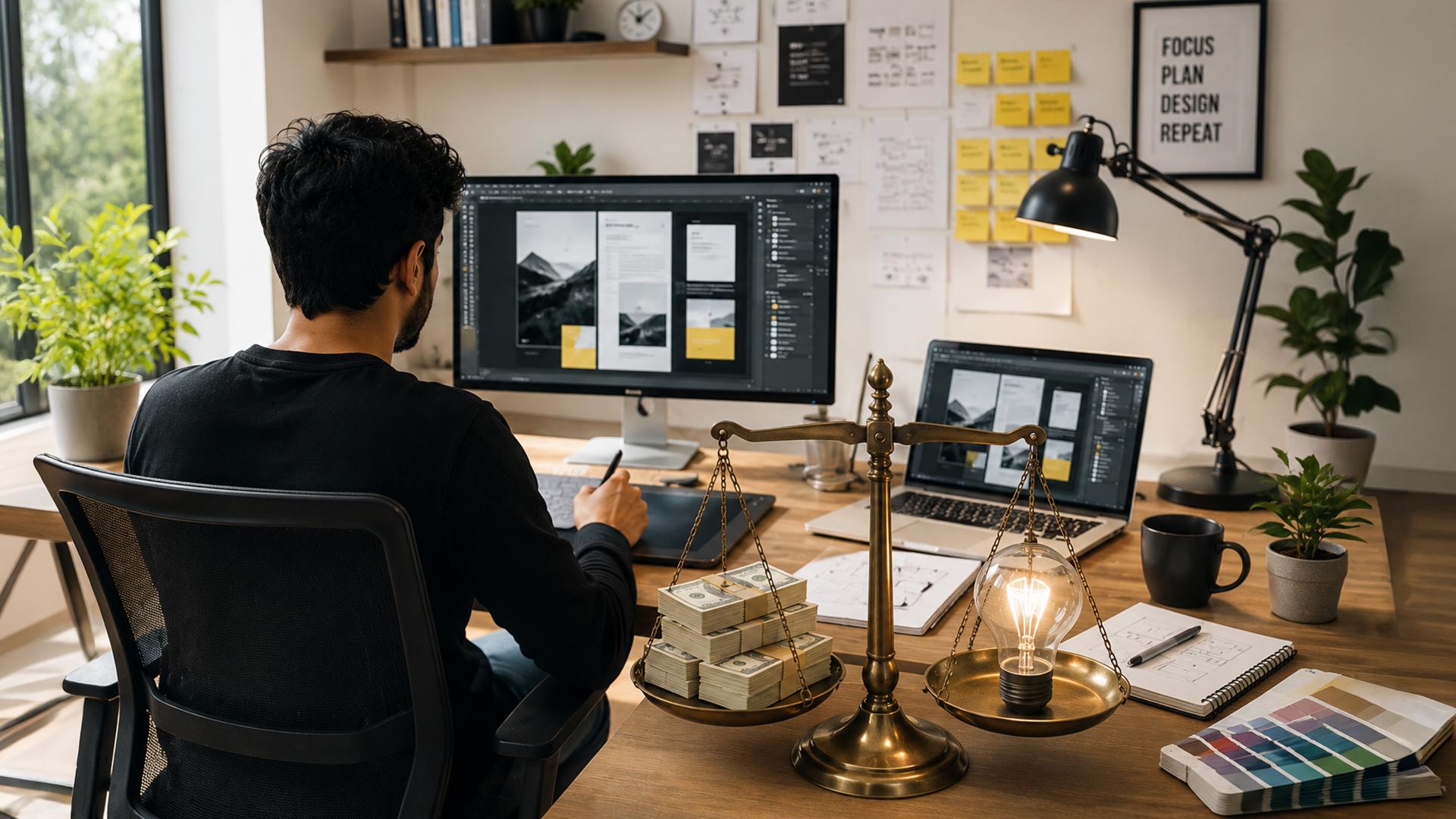
"What should I charge?"
After 12 years of freelancing in India and delivering over 400 websites, 75,000+ graphics, and 40+ CGI ad campaigns, I have a clearer answer than I did when I started. But I want to be honest with you upfront — there is no single right number. Pricing depends on your skills, your city, your client type, and the kind of life you are trying to build with this work.
What I can give you is the framework I actually use, the numbers I see other Indian freelancers charging in 2026, and the mistakes that kept me underpaid for far too long.
Why Indian designer pricing is a confusing mess
If you Google "freelance design rates in India" you will find numbers all over the place. ₹500 for a logo on one site. ₹50,000 for a logo on another. Both real. Both correct depending on context.
Here is what is actually happening. The Indian freelance market has three completely separate layers operating at the same time:
Layer one — the commodity layer. Fiverr, Freelancer.com, and similar marketplaces. International competition. Race-to-the-bottom pricing. Logos for ₹500. Websites for ₹3,000. Most freelancers here are competing against designers in Bangladesh, Pakistan, the Philippines, and other markets with very different cost structures. The work is volume-based, the margins are thin, and the clients are usually small businesses or international buyers looking for the cheapest possible option.
Layer two — the local market. Direct clients from your city or state, found through word of mouth, Instagram, local agencies, and references. Pricing depends heavily on the client's perception of what design "should" cost. A small business in Tier 2 India often expects to pay ₹5,000–15,000 for a website. A growing startup in Mumbai or Bangalore is comfortable paying ₹50,000–2,00,000 for the same scope.
Layer three — the premium freelance layer. Designers who have built a personal brand, who position themselves as specialists, and who attract clients that already understand the value of good design. Pricing here starts at ₹1,00,000 for a website and goes up. This is also where international clients usually land — they pay USD rates ($1,500–$15,000+ for a project), which converts to far more than local Indian pricing.
Most Indian designers spend their first 3–5 years stuck in Layer one or the lower end of Layer two, thinking that is just what the market pays. It is not. You move between these layers based on positioning, portfolio, and the type of client you actively seek out — not based on years of experience.
My real pricing in 2026 — for context
Let me show you what I charge today, so the numbers below have a real reference point. I am not the cheapest designer-developer in India and I am not the most expensive. I sit in the middle of Layer three.
Logo design — ₹15,000 to ₹40,000 depending on usage rights and revisions.
Brand identity package — ₹50,000 to ₹1,50,000 (logo, color system, typography, brand guidelines, social templates, business card).
WordPress website — ₹35,000 to ₹1,25,000 depending on pages, custom theme work, and e-commerce.
Next.js custom web application — ₹75,000 to ₹4,00,000+ depending on features, database complexity, and admin panel needs.
3D / CGI ad — ₹40,000 to ₹2,00,000 per project depending on length, render complexity, and licensing.
Event branding (the SRH × CUB type projects) — ₹60,000 to ₹2,50,000 for full event identity systems.
Monthly retainer for ongoing design + development support — ₹35,000 to ₹1,25,000 per month depending on scope.
These are not made-up numbers. These are what real clients actually pay me right now in 2026. And they took me a decade to feel comfortable quoting. If you are starting out, your numbers will be lower than this, and that is fine. Use these as a reference for where the ceiling can be, not where you have to start.
The honest pricing ranges across Indian freelance levels
Here is the breakdown I share with newer designers when they ask. These ranges are based on direct conversations with dozens of working freelancers across Indian cities in 2025–2026.
Beginner — 0 to 2 years of experience
You are still building your portfolio. Your work is good but not yet refined. You take any client you can get.
Logo design — ₹2,000 to ₹8,000
Single landing page (WordPress) — ₹8,000 to ₹20,000
Multi-page WordPress site — ₹15,000 to ₹35,000
Social media post (single design) — ₹300 to ₹800
Monthly social media package (15 posts) — ₹5,000 to ₹15,000
Basic brand identity — ₹8,000 to ₹20,000
Most beginners spend too long at this stage because they think the next client will magically pay more. They will not. Your prices go up when your positioning, portfolio, and clients change — not when more time passes.
Intermediate — 2 to 5 years of experience
Your portfolio is solid. You have repeat clients. You can confidently say no to scope creep.
Logo design — ₹8,000 to ₹25,000
Brand identity package — ₹25,000 to ₹60,000
WordPress website (custom theme) — ₹35,000 to ₹85,000
Next.js website (basic) — ₹40,000 to ₹1,20,000
E-commerce store (Shopify or WooCommerce) — ₹50,000 to ₹1,50,000
Monthly retainer — ₹20,000 to ₹50,000 per month
The mental shift at this level is harder than the skill shift. You have to start saying "this project is ₹75,000" without flinching, and you have to stop apologizing for that number.
Advanced — 5 to 10 years and well-positioned
You have a personal brand. Clients come to you because of who you are, not just what you do. You probably have a website that ranks for your name and city.
Logo design — ₹20,000 to ₹50,000
Brand identity package — ₹60,000 to ₹2,00,000
Next.js custom web application — ₹1,00,000 to ₹5,00,000
E-commerce platform with custom features — ₹1,50,000 to ₹6,00,000
3D / CGI work — ₹50,000 to ₹3,00,000 per project
Monthly retainer — ₹40,000 to ₹1,50,000 per month
Expert / specialist — 10+ years with a strong niche
You are known for one specific thing. People recommend you by name in WhatsApp groups, LinkedIn posts, and design Slack channels.
Brand identity (full system) — ₹2,00,000+
Web platform / SaaS product build — ₹4,00,000 to ₹25,00,000+
Speaking, consulting, design strategy — ₹15,000 to ₹50,000 per session
International clients (USD billing) — typically 2–4x your INR pricing
Why most Indian designers undercharge — and how to stop
I see the same five mistakes in almost every conversation I have with underpaid freelancers. If any of these sound familiar, you are leaving money on the table.
Mistake one — pricing based on time, not value. You worked four hours on the logo, so you charge ₹2,000. That logic ignores everything else: the 10 years of skill you brought to those four hours, the strategic thinking behind the design, the way that logo will affect the client's revenue for the next decade. Price based on the outcome the client receives, not the hours you spent.
Mistake two — quoting one all-in number. When a client asks "how much for a website" and you say "₹50,000", they hear a ceiling. When you break it down into design, development, copywriting, SEO setup, and hosting — and price each component — clients understand what they are paying for, and your total quote becomes more defensible.
Mistake three — accepting "I'll pay you after the project" arrangements. A 50% advance is not negotiable for me anymore. The clients who push back on this are exactly the clients who will not pay you at the end. Decent clients understand this is industry standard.
Mistake four — not raising rates for existing clients. Your prices should go up every 6–12 months. Most freelancers are scared to do this with existing clients, so they take on new clients at higher rates and stay stuck with old clients at outdated rates. Send a polite email. Most good clients will understand. The ones who do not are not worth keeping.
Mistake five — treating revisions as unlimited. Every package I send specifies "2 rounds of revisions included. Additional revisions billed at ₹X per round." This single line has saved me hundreds of hours of frustration.
How to actually move from beginner pricing to professional pricing
The jump from charging ₹5,000 for a website to charging ₹75,000 does not happen because one day you decide to quote a bigger number. It happens because of a sequence of moves.
Step one — get your own portfolio in order. I rebuilt my portfolio at nitinmonga.in in early 2026 because the old version was holding me back. If your portfolio looks like it was designed in 2019, no one will believe you can charge 2026 rates. Even if your work is brilliant, the wrapper matters.
Step two — start working in public. Post your process on Instagram and LinkedIn. Write case studies (not just pretty pictures — actual stories about the project, the constraints, your decisions). The clients who pay premium rates are the ones who saw you working before they ever messaged you.
Step three — niche down, even temporarily. "I design websites" is a hard sell. "I design websites for fintech startups in India" is easier to charge for. "I design lyrics platforms with custom database architecture" gets you ₹4 lakh projects because nobody else describes themselves that way. You can broaden your offering again later — but a niche is the fastest way to escape the commodity pricing trap.
Step four — stop competing on Fiverr. I know it feels safe to have those gigs running. But every hour you spend on a ₹2,000 Fiverr logo is an hour you are not spending on outreach to clients who would pay ₹40,000 for the same work. Cut the bottom of your client portfolio. The fear of "what if no new clients come" is exactly what keeps you stuck at the bottom.
Step five — write your proposals like a senior designer. No more one-line WhatsApp quotes. Build a proper proposal document with scope, timeline, deliverables, payment terms, and your portfolio links. The act of sending a professional proposal often justifies a higher price by itself.
What clients actually pay for in 2026
After working with everyone from local Punjab businesses to IPL teams and global SaaS startups, I can tell you what makes the difference between clients who haggle and clients who pay your full quote without blinking.
They pay for clarity — they want to know exactly what they get, when they get it, and how revisions work.
They pay for proof of work — case studies, testimonials, and a portfolio that demonstrates you have done this kind of work before.
They pay for professionalism in the process — contracts, advance payments, proper file delivery, recorded handover walkthroughs.
They pay for outcomes, not deliverables — a website that converts, a brand identity that gets noticed, an ad that gets shared. Frame your work around what it does for them, not what it is.
And honestly, they pay for your time, your taste, and your judgment. After 10 years of doing this work, those three things are what I sell. The logo or the website is just the artifact.
Final thoughts — pricing is a relationship with yourself first
The hardest part of pricing is not the spreadsheet. It is the moment you have to look a client in the eye and say "this project is ₹1,50,000" without flinching, without apologizing, without immediately adding "but I can do it for less."
That confidence does not come from years of experience. It comes from doing the work to know your value and being okay with the clients who walk away. The right clients — the ones who respect your craft and your time — will never walk away because your price is fair. They walk away when they sense you do not believe in your own price.
Charge what your work is worth. Build the portfolio that justifies it. Then say the number with a straight face. Everything else follows.
If you are thinking through your own pricing or planning a project, you can see my full case studies and recent work at nitinmonga.in. And if you want to work together, the contact page has a form that walks you through scope, budget, and timeline — designed exactly the way I wish more client-side proposals were written.
Tagged
Nitin Monga
Graphic Designer, 3D Artist & Full-Stack Developer based in Punjab, India. Designing and building digital products since 2013.