I Built Vizloft: A Product Discovery Platform for Independent Builders, Here Is Why
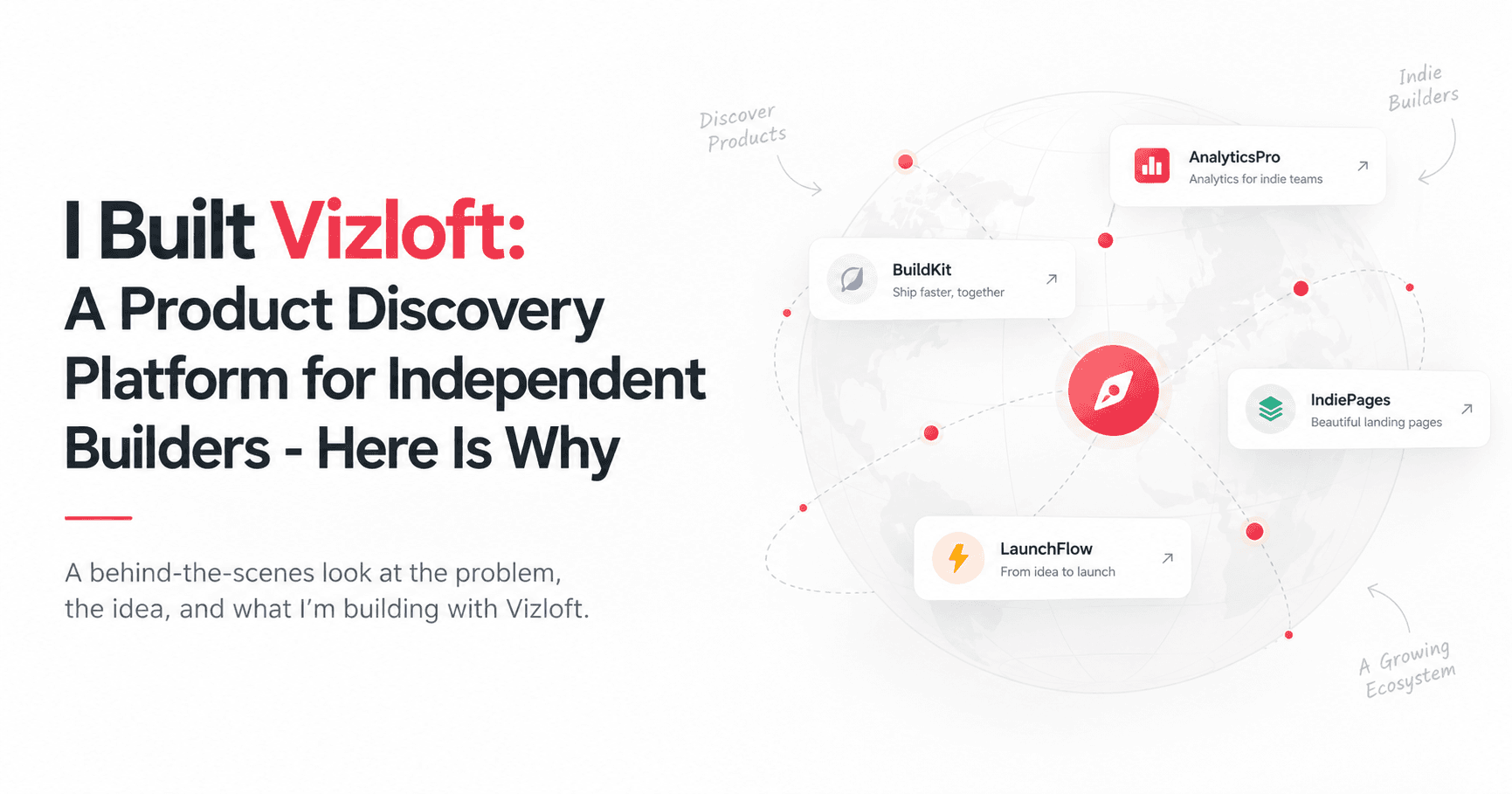
Nitin Monga, designer and developer from Punjab, built Vizloft - a free platform where independent builders list their products, explore builders on a live Atlas map, and find their people. This is the story behind it.
Nitin Monga
Designer · Developer · 3D Artist
There is a particular kind of loneliness that comes with building something on your own.
Not the loneliness of being physically alone, although that is often part of it too. The loneliness of not knowing whether anyone else is building the same kind of thing. Not knowing whether the person two cities over is solving a problem similar to yours. Not knowing whether a conversation with the right person at the right moment could have changed the direction of something you spent months on.
I have felt that loneliness for most of my career. Twelve years of building products, running an agency, launching things into the world, and spending a disproportionate amount of that time not knowing where the other builders were.
That is what Vizloft is about.
The Problem I Was Actually Solving
When I started thinking seriously about building a product discovery platform, my first instinct was the obvious one. Build something like Product Hunt. A launch platform. A leaderboard. An upvote system.
I spent several weeks thinking through what that would look like. And somewhere in that process I realized I was solving the wrong problem.
Product Hunt already exists. It works. Thousands of products launch there every week. The problem is not that there is nowhere to launch a product. The problem is something quieter and more specific than that.
When you are an independent builder, a solo developer, a designer who codes, a founder who has not yet found a co-founder, you are not primarily looking for a launchpad. You are looking for people. You are looking for the person who understands what you are building and why, because they are building something adjacent. You are looking for the conversation that only happens when two people are working in the same territory and they finally find each other.
That is a different problem. And it is the problem Vizloft is built to solve.
What I Built
Vizloft is live at vizloft.com. It is a product discovery and builder network for independent builders worldwide.
The listing part works simply. You go to vizloft.com/list, enter your product URL, review the details the system pulls in, verify your email, add your location, and your product gets a free public page after a quick review. No payment required. Every approved product gets its own public URL, discoverable and indexed.
But the listing is really just the mechanism for getting a builder onto the platform. The more interesting part is what happens after that.
Atlas
Atlas is the feature I am most proud of.
Every builder who lists a product chooses to share their city. Not a precise address. Just the city. When you open vizloft.com/atlas you see a live world map showing where those builders are. Each marker represents a builder or a cluster of builders in the same city. The map is filterable by city and country.
Right now there are builders on Atlas from cities across India, from Shenzhen in China, from Los Angeles in the United States, with more being added as new products get listed. Faridkot. Mohali. Bengaluru. Mumbai. Delhi. Hyderabad. Pune. Ranchi. Coimbatore. Lucknow. The map is filling in city by city, builder by builder.
The reason Atlas matters is deceptively simple. When you can see where builders are, you stop feeling like you are building alone. You start feeling like you are part of something that has geography, that exists in real places, that is not just a feed of links. The builder in Ranchi working on a productivity tool and the builder in Shenzhen shipping an AI product are both visible on the same map. They may never have found each other otherwise.
Spotlight layers on top of Atlas. Builders who earn Spotlight appear with a ringed red marker on the map, visible to everyone browsing. It is a temporary featured placement, earned through community activity, separate from the organic discovery every builder already gets by default.
Find Matches
If Atlas shows you where builders are, Find Matches shows you who they are in relation to what you are building.
When you create a builder profile on Vizloft and list your products with their categories, Find Matches uses those categories to surface other builders working in similar spaces. Building a design tool? The system finds other builders in design. Building an AI product? It surfaces others in that space. All through their public profiles and the links they chose to share.
This is not a social network. There are no DMs on Vizloft, no follower counts, no engagement metrics. Find Matches simply makes the connection visible and then steps back. The actual conversation happens wherever the builder chose to point their profile, whether that is X, LinkedIn, Instagram, or a personal site.
Builders should own their connections. The platform facilitates discovery and then gets out of the way.
Build Signals
Build Signals is newer and the feature that most directly answers the loneliness problem.
It is a live feed at vizloft.com/signals where builders share what is happening with their product right now. Launches, updates, milestones, opportunities. When Gehna Studios launched today, that appeared in Build Signals. When DJYoungster added its entertainment platform to Vizloft yesterday, that appeared too.
The feed is filterable by type. You can see only launches, only updates, only milestones, only opportunities. If you are looking for a collaborator or beta user or feedback on something specific, you post it under opportunities and the community sees it.
What this creates is a sense of motion. The platform is not a static directory. Things are happening. People are building, launching, updating, making progress. Seeing that activity is its own kind of encouragement when you are in the middle of a difficult week on your own project.
Why I Seeded It With My Own Products
When Vizloft launched I listed my own products first. The UI Design Analyzer, the YouTube Keyword Tool, RaiseKnowledge. My own work went in before I asked anyone else to list theirs.
This was not a strategy. It was the only honest way to do it.
You do not ask other builders to trust a platform you have not trusted yourself with your own work. You do not tell someone the listing process is simple unless you have actually gone through it. You do not claim the product pages look good unless you have seen your own product on one.
The UI Design Analyzer is currently ranked number one on Vizloft by upvotes. The YouTube Keyword Tool is ranked number two. Not because I gamed the system but because they were the first listings and picked up votes from the first builders who joined. Eventually other products will overtake them and that is exactly what should happen.
The Name
Vizloft is an invented word. I wanted something that did not already mean something, something that the platform could define rather than the other way around.
The loft part matters to me. A loft is a space where things get made. Workshop energy. Independent work. The kind of space where someone is building something and it is not yet finished and that is fine, because being in the process of building is the whole point.
Viz is about visibility. Building something only matters if it gets seen.
Vizloft is where builders become visible. Where the thing you are making in your loft gets a place on the map.
Who It Is For
Vizloft is for independent builders worldwide. Side projects, first launches, solo tools, products that are not yet polished enough for a major launch platform but deserve to exist somewhere that is not just a tweet or a Reddit thread.
The platform deliberately welcomes what it calls side projects and first launches. There is no minimum quality threshold beyond being a real product that exists and works. A student building their first web app belongs on Vizloft the same way a seasoned developer's tenth side project does.
The directory currently has products across AI, developer tools, productivity, design, no-code, finance, e-commerce, SaaS, education, creator tools, lifestyle, health, and more.
What Vizloft Does Not Promise
There are a few things Vizloft is straightforward about not doing.
It does not guarantee search rankings or indexing. Every approved listing gets submitted for indexing and gets a public page, but search engines make their own decisions. Vizloft gives a product another place to be discovered. It does not control what Google does with that.
It does not replace the work of building an audience. A listing on Vizloft is not a substitute for content, for community, for showing up consistently in the places your potential users already are. It is one more legitimate place your product can be found.
It does not manufacture connections. Find Matches surfaces possibilities. The actual relationship between two builders happens outside Vizloft, on their own terms, through whatever channels they choose.
Where It Is Going
Vizloft is early. Seventeen live products. Thirty-two builders from multiple countries already on the Atlas. The Build Signals feed starting to show real activity. The bones are there and they work.
The direction from here is more of what makes it distinctive. More builders on the map. More geographic density in more cities. More categories and better matching. A signals feed that becomes a genuine daily read for anyone who wants to know what independent builders are shipping right now.
Listing a product on Vizloft is free and always will be. There is a paid Pro tier for builders who want additional visibility and features, but the core of the platform, getting a public page, appearing on Atlas, using Find Matches, posting to Build Signals, costs nothing.
If you are building something, whatever stage it is at, it belongs on Vizloft.
Tagged
Nitin Monga
Graphic Designer, 3D Artist & Full-Stack Developer based in Punjab, India. Designing and building digital products since 2013.